The car pulls to the side: when is wheel alignment to blame, and when is the problem more serious?
Does the car pull to the right or left? The reason is not always camber-toe. We figure out when it is enough to adjust the geometry of the wheels, and when it is worth checking the tires, suspension and brake system.
The car pulls to the side: when is wheel alignment to blame, and when is the problem more serious?
Release the steering wheel on a flat road - and the car gradually goes to the right or left? The first thought is usually the same:"You need to make a wheel alignment".
Sometimes it really helps. But the reason can be completely different: from incorrect tire pressure to problems with the suspension or brakes.
Therefore, before you go to adjust the geometry, it is worth finding the real reason.
When is wheel alignment really to blame?
Incorrect wheel alignment angles can cause:
- diverting the car to the right or left;
- crooked steering wheel position;
- instability in a straight line;
- uneven tire wear.
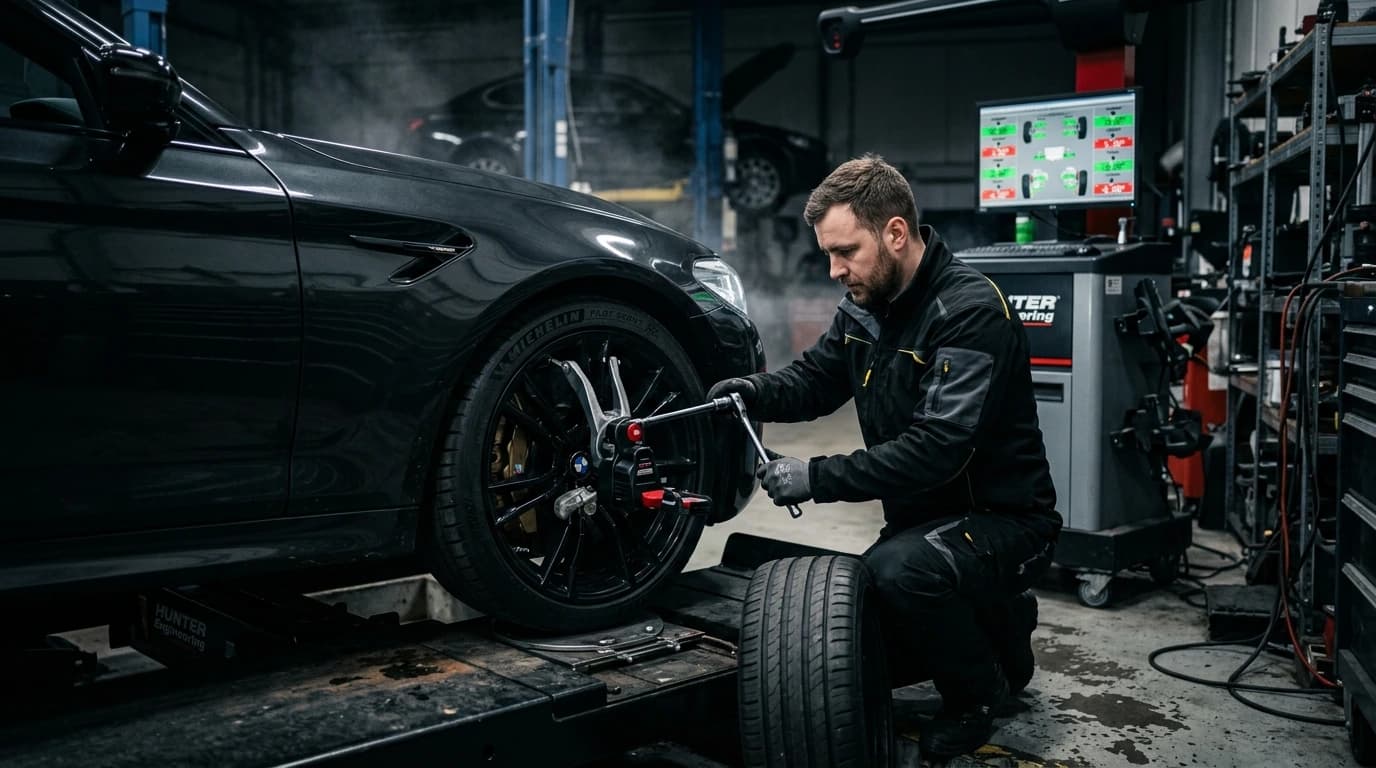
The geometry is often disturbed after hitting a hole hard, hitting a curb, or repairing the suspension.
But an important point:It makes no sense to do wheel alignment on a faulty chassis. If there are backlashes in the levers, silent blocks or steering tips, the settings will quickly go astray again.
1. Incorrect pressure or tire problems
It's worth starting with the simplest.
If the pressure in the wheels of one axle is different, the car may pull to the side. A similar effect is given by:
- unevenly worn tires;
- deformed tire;
- different tire models on the same axle;
- damage after impact.
Therefore, before a complex diagnosis, it is worth checking the pressure and condition of the rubber.
2. Wedges brake caliper
If one wheel constantly slows down a little, the car can be pulled in its direction.
Additional symptoms:
- the wheel heats up more than the others;
- there is a smell of overheated brakes;
- rolling worsens;
- the car pulls to the side when braking.
This is no longer just a matter of comfort - a malfunction of the brake system should not be ignored.
3. Worn suspension parts
Silent blocks, ball joints, levers, tie rods and tips keep the wheel in the correct position.
When backlash appears, the car can:
- "swim" along the road;
- react to the track;
- change trajectory during acceleration or braking;
- wear tires unevenly.
In this case, the chassis is first repaired, and only then wheel alignment is performed.
4. Shock absorbers and springs
A sagging spring or worn shock absorber changes the load on the wheels and the behavior of the car.
The car may hold its trajectory worse, swing on bumps, or become unstable at speed.
That is why the diagnosis of the chassis should be comprehensive.
5. Consequences of hitting a hole or curb
After a strong impact, not only geometry settings can suffer.
Sometimes deformed:
- rim;
- lever;
- tie rod;
- suspension elements.
If the car began to pull immediately after impact, the right decision isFirst diagnostics, then wheel alignment.
How to find the cause correctly?
The optimal sequence looks like this:
- Check tire pressure and condition.
- Inspect the wheels and rims.
- Check the suspension and steering for play.
- Make sure the brakes don't wedge.
- After troubleshooting, check the wheel alignment.
This approach helps not to mask the symptom, but to eliminate its cause.
When is it better not to postpone diagnostics?
It is worth contacting the service as soon as possible if, along with the withdrawal of the car, there are:
- strong vibration;
- knocking in the suspension;
- change in behavior during braking;
- smell of overheated brakes;
- noticeable deterioration in handling.
In such cases, the problem can be much more serious than the usual geometry adjustment.
Wheel alignment is not a universal cure
If the car pulls to the side, you should not immediately go "to the camber".
Sometimes the reason is banal - wheel pressure. Sometimes you need to adjust the geometry. And sometimes the problem lies in the brakes or worn suspension.
Our specialists will conduct a comprehensive diagnosis of the chassis, check the condition of the wheels, steering and brake system, find the reason for the car's withdrawal and offer the right solution.
Do not get used to constantly "catching" the car with the steering wheel -A serviceable car must confidently keep the trajectory.
Related articles